During the period of the Six Dynasties, wars occurred frequently in the north but the south was comparatively stable. The shifting of a large number of population and technical strength to the south promoted the exploitation and development of the south. The situation of taking the north as the center of economy and handicraft production for a long time began to change and a new situation was formed for the whole nation to develop in a balanced way.
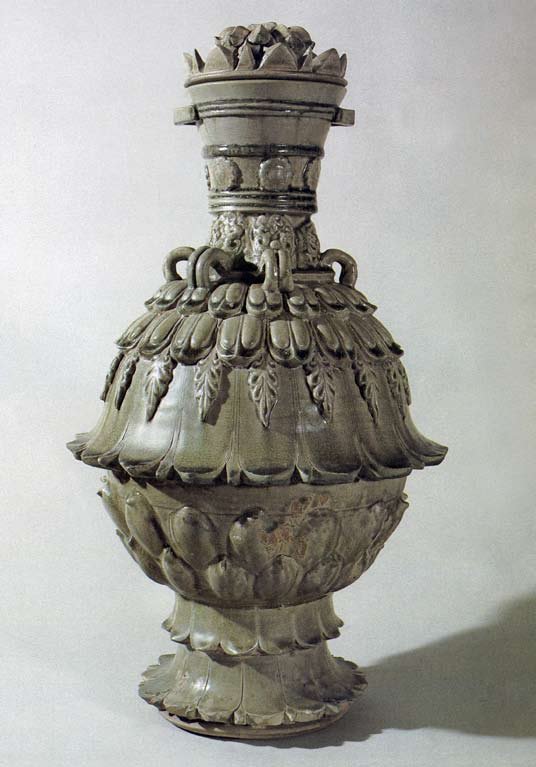
The Six Dynasties, inheriting upward from the Western Han Dynasty and the Eastern Han Dynasty and handing down to the Sui Dynasty and the Tang Dynasty, was an important transitional period in the handicraft history of China. The turbulence of the society, the sufferings brought about by the war, and he mental agony gave an opportunity to the rise and dissemination of Buddhism to publicize karma and samsara and the rulers also made use of Buddhism to consolidate their rule. As a result, Buddhism was energetically encouraged. In the north, grottoes in Dunhuang, the Datong Grottoes, and the Luoyang Grottoes are all the pioneering works left from that time. In the south, Buddhism. Many a brass or copper ware, gold vessel, silverware, carved stone, textile, embroidery and lacquer ware all contained the subject of Buddhism. Lotus and honeysuckle, the main ornament at that time, became the symbols of Buddhism. The prevalence of Buddhism also contributed to and expanded international exchanges. The visit of monks from India and craftsmen from the Western Regions introduced the Indian art compromising the Greek and Persian styles to China and impelled the handicraft culture of China to carry out a new synthesis. Therefore, the religious trend and foreign style of the industrial art are the important handicraft features of the Six Dynasties.