Shanghai Museum

Address: Shanghai, Peoples Great Road, #201 The scope, depth and quality of its collections, and the striking architecture and use of modern technology make the Shanghai Museum one of the most famous if not the most famous in China. It covers an area of 38,000 square meters, with a scale that surpasses the old museum … Read more

Packaging

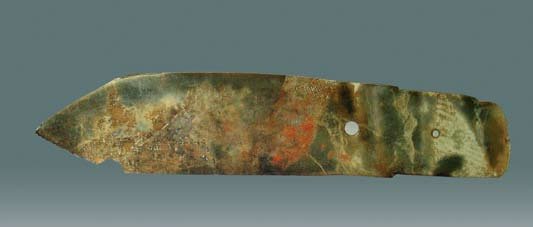
Shang Dynasty jade dagger-axe treasured in Palace Museum. The silk and hemp fabric packaging closely adhered to the surface owing to the passage of time.

Packaging is closely related to people’s daily life. Traditionally the guidelines on packaging in China are always “for the convenience of the users” and “pleasing to the eyes.”

In earlier days, natural materials were used in packing such as tree leaves, bamboo, lotus leaves, palm leaves, gourds, cocoanut shells, shells of shellfish, animal skin, etc. Later on, man-made material were used including fabrics, ceramics, metals, lacquer ware, woodware, jadeware, paper, etc. As early as the late years of the primitive society, packaging had already started. Bamboo tubes, gourd shells, cocoanut shells, earthen jugs, etc. were used to hold liquids; baskets made from bamboo or willow twigs, were used to hold solid objects. Sometimes commodities were directed wrapped in bamboo leaves, lotus leaves, etc. In China materials, ornaments and styles in packaging differ in different historical periods, changing with the productivity, and scientific and technological development, and conforming to the fashion of the time.

The pottery wares emerged in the Neolithic Age was the first great invention of man-made packaging materials. In comparison with natural materials, they have the advantages of being durable, antiseptic, and anti-worm-eaten. They also excel in long-distance transportation and in being various in forms. It is interesting that the earliest food cans were discovered in China – the twelve airtight food cans unearthed in Baoshan of Hubei in 316 B.C. These cans were tightly sealed with multi-layer materials such as straw mats, bamboo leaves, wet clay, etc. Individual cans were cased with bamboo baskets having a handle above for convenient carrying. On the outmost layer, silk was covered before they were tied up with thin bamboo strips or silk ribbon, which were sealed with clay, attached with label bearing the description of the food contained in the can. By this process the food can be kept for a long period of time without going bad or discoloring.
Read more

Gold and silver ware

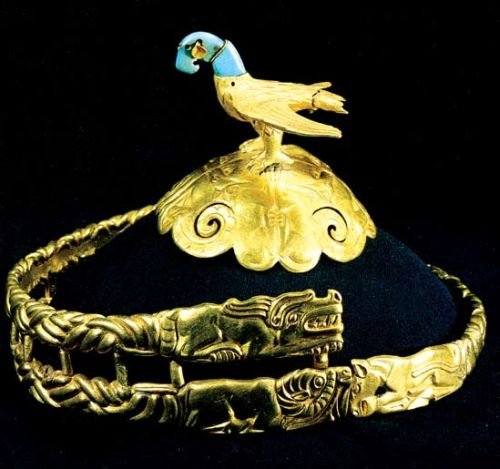
Eagle decorated golden crown top and golden crown belt of the Warring States Period.

The major methods for processing fold articles originated from bronze making, which include smelting, mould founding, hammering, welding, bead-forming, engraving, wire-twining, wire inlay, etc., but developed or innovated. Take the bead-forming craft for example. It is an art unique to gold processing in which the first step is to let melted gold drip into warm water drop by drop to form beads of various sizes, and then by welding each tiny drop of gold, fish-egg patterns or bead-string patterns are made. Silverware turned up later than gold, and followed gold articles in working procedures.

From the very beginning gold and silver articles came out as artworks. The existing earliest gold objects were made in the Shang Dynasty more than 3,000 years ago. They were mostly ornaments, simple in shape, small in size, with less decorative patterns. The Shang-dynasty gold articles were chiefly gold and silver foil, gold leaves and sheets, used to adorn utensils; only a few in the northern and northwestern regions were used for personal adornment. Of the earlier gold articles, the gold masks and the gold staffs unearthed from the early Shu-culture ruins in Sanxingdui of Guanghan, Sichuan Province, are the most eye-catching. In the Shang and Zhou dynasties, the bronze techniques and the jade carving both facilitated the growth of gold and silver crafts.

Read more