Toy

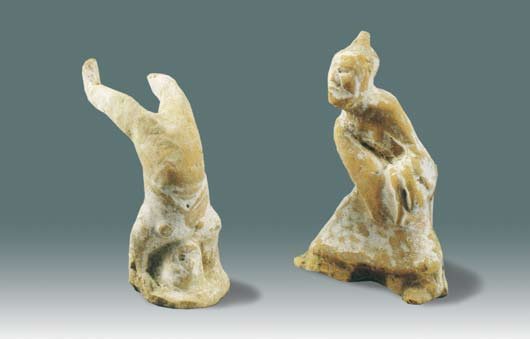
Han Dynasty red pottery acrobat figurines

Since ancient times to this day, toys have always accompanied human life. Early in the Neolithic Age, primitive toys already emerged. Folk toys in China have existed for a long time, spread to a wide area, with diversified types and styles made from numerous raw materials. In terms of functions they fall into seasonal toys, intelligence improving toys, acoustic toys, intelligence improving toys, acoustic toys, keeping-fit toys, toys for viewing and enjoying, and practical toys. In terms of materials used, they can be divided into clay toys, cloth toys, bamboo and wooden toys, paper toys, etc.

Seasonal toys are closely connected with folkways, subject to a certain season or festival time. Firecrackers and fireworks are special for Spring Festival time. Firecrackers and fireworks are special for Spring Festival; running horse lantern and auspicious image lanterns for Lantern Festival; lotus lantern for Spirit Festival; sachet, cloth tiger, moxa-filled figure, five-filamet whistle for Dragon-boat Festival; grandpa rabbit for Mid-Autumn Festival; kite for Pure Brightness; etc. Educational toys can arouse people’s curiosity and encourage creativity such as tangram, informative map, playing card, small game “puzzle,” nine-circle puzzle, Lubanga lock, problem palace rearrangement. Acoustic toys such as earthen whistle, china whistle, diabolo, wheels (wooden shaft at either end of a disk), rattle-drum, tiny gong and drum, glass trumpet, etc., can send out sounds, suitable for babies. Toys for viewing and enjoying are mainly for decoration, such as wood carvings, stone carving, front-stone carvings, clay figures, was figures, dough figurines, etc. Keeping-fit toys are mostly for outdoor activities such as Cuju (ancient game similar football), rope skipping, shuttlecock, swing, pot vote (a throwing game). Practical toys can also be used as dress, bedding, food, such as tiger-head shoes, tiger-head cap, sugar figuring, flower face (a kind of bun), etc. Details are given to some of the above-mentioned toys as below.
Read more

Henan Museum

Address: Henan Province, Zhengzhou City, Nongye Road, #8 The Henan Museum is one of China’s oldest museums. It is a ‘key’ museum, with modern displays and exhibitions, modernized equipment, and a unique architecture. In 1961, along with the move of the provincial capital to Zhengzhou, it moved to its current location. In 1991 that museum … Read more

Kite

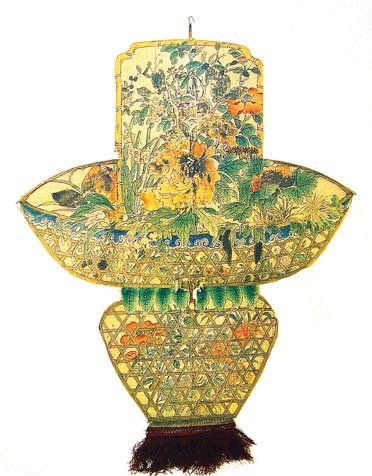
Flower-basket kite made from juan-silk and bamboo in Weifang, Shangdong

Kite is one of the most typical Chinese folk toys. It incorporates into a whole appreciation, entertainment, competition, exercise, and is closely connected with folkways, festivals, science and technology, history, etc., fully revealing the rich content of folk toys. Flying kites often occurs on the occasion when people go for an outing around the Pure Brightness Day. In the past people used to write their own names on the kite when they were in distress of fell ill. As the kite was flying high above, they cut the string and let the kite fly away with the wind. In so doing they believed that their bad luck had gone with the kite.

The name of kite varied in different period of times. Some ancient book written in the pre-Qin period records that the thinker Mo-tzu and the master craftsman Gongshu Ban had both made something called “wooden hawk.” Later on it was said that the distinguished general Han Xin (?-196 B.C.) ever made “paper hawks” in the first years of Han Dynasty. According to more reliable source, the kite originated in the Northern and Southern Dynasties. It was named “paper crow” or “paper owl” at that time. The kite was not used as a toy but used in military affairs, correspondence, measurement, publicity, etc. It was after the Five Dynasties that the kite became popular and turned to be a means of entertainment. During the mid-Tang Dynasty, paper started to be more widely used in everyday life and gradually replaced other more expensive materials in making kite thanks to its low cost and easy working process.

By the Song Dynasty, kite-flying was popularized; kite-making became an occupation. Gradually the custom of flying kites at the Pure Brightness Festival was established. Scenes of flying-kite can be seen in both the famous painting Pure Brightness Day on the River by Zhang Zeduan, eminent artist of the Northern Song Dynasty and the picture One Hundred Sub-graphs by Su Hanchen.

Read more