Puppet

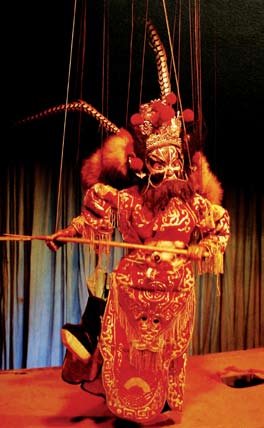
Performance of marionette show at Heyang, Shaanxi

Puppet made its appearance for the first time in the Spring and Autumn Period. In 1979, a puppet was unearthed from a Han Dynasty tomb in Laixi of Shangdong Province. The puppet, 193 centimeters in height and composed of thirteen articulated parts, can be made to sit, stand or kneel. The discovery indicates that the function of puppets at that time had shifted from being a funerary object to a thing for entertainment, which foretold the birth of puppet show.

In the classic writing Tong dian (Laws and Rules Recorded) written by Du You of the Tang Dynasty, there is a short passage which goes, “in the last years of Han Dynasty, puppets started to perform for entertainment on grand occasions. In earlier times, they were used only ar funerals.” By the Sui Dynasty, the embryonic form of puppet show had taken shape. Even scenes from traditional opera could be performed with puppets. From the Tang murals and poems of the prosperous period of Tang Dynasty stored in Cave No. 31 of Mogao Grottos in Dunhuang, Gans Province indicate that different categories of puppets including glove puppets, marionettes and rod-hand puppets had already appeared.

The puppet show came to its prime in the dynasties of Song and Yuan. Puppet show troupes mushroomed in Song Dynasty, offering performances of various subject matters. From Yuan Dynasty, puppets could be manipulated to act vividly the gamut of human emotions-happiness, anger, grief and joy.

From the Ming down to the Qing Dynasty, diversified schools of puppet show spread all over the country, each with local flavor of its own. Take the marionette show in Quanzhou of Fujian Province for an example. Not only was the music accompaniment excellent, but also were the puppets exquisitely made and manipulated with superb skills. A single puppet figure could be controlled by as many as twenty up to thirty strings. In Qing Dynasty, rod puppet show prevailed among which the Beijing rod puppet show was played in the royal court as a special-form Peking opera.
Read more

Enamelware

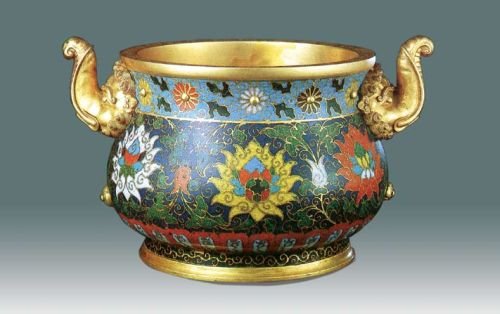
Yuan Dynasty pinch-wire elephant-ear heater, housed in Palace Museum. It is a gold gilded copper coatd with enamel that looks refined and gorgrous.

The enamelware manufacturing craft is actually a complex process combining enamel process and metal process. It is prepared by first grinding quartz, silicon, feldspar, borax, ans some metal minerals into powder ans then melting and then applying on metal utensils to form a surface after backing. Sometimes polishing or gold-plating is needed. Enamelware which has he sturdiness of metal, the smoothness and corrosion-resistance of glass, is practical and beautiful. To date the earliest enamel object made in China is the Tang-dynasty gold-inlaid silver-base enamel mirror now kept in the Shosoin Repository of Nara, Japan. But no other enamelware was found in the three of four hundred years afterwards. In the late years of the

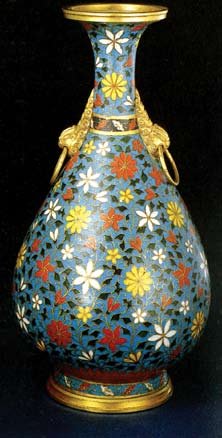
Ming Dynasty pinch-wire enamel bottle, housed in Palace Museum.

Yuan Dynasty, Chinese enamelware became less influenced by Arabian culture and more and more nationalized.

Enamelware includes gold-inlay enamel, coating enamel, painting enamel in terms of processing methods, and gold-base enamel, copper-base enamel, porcelain-base enamel, glass-bass enamel purple-clay enamel, etc. in terms of bases. Among them the copper-base enamel is he most popular, because the copper price is relatively lower, and enamel is easier to adhere to the copper surface. The distinguished traditional Chinese handicraft Jingtailan (cloisonné enamel), its scientific name being copper background wire-inlay enamel, got its name from being made in large quantities in Beijing during the Jingtai Reign of the Ming Dynasty, and the enamel used was mostly of a blue color. The procedure of Jingtailan includes chiefly base-making, wir-inlaying, firing and soldering, blue enamel coating, enamel-baking, polishing, and gold-plating. Coating is done byusing small iron spade or glass tube to apply glaze of different colors first in the background, then on the designs and then finally to the blue glaze and add some shiny white substance. Glazing and baking procedure is done repeatedly, one blazing followed by one backing, often three times are needed for quality cloisonné.

Read more

Printing and Dyeing

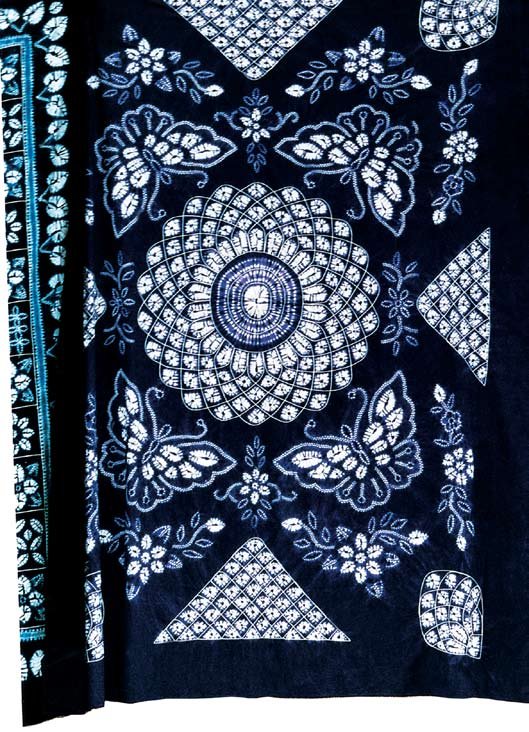
Batik works of Bai nationality in Dali, Yunnan Province.

Dyeing textile using minerals and plants is a time-honored practice in China. Early in the Neolithic Age some six to seven thousand years ago, the Chinese ancients could already dye red sackcloth with hematite powder. Through long-term practice in production, Chinese people had learnt the techniques of dye-extracting and application to yield colorful fabrics.

During the Shang and Zhou dynasties, with dyeing techniques gradually improved, governmental officials were appointed such as “dyeing men,” “dyestuff keepers,” etc. in charge of relative affairs. In the ancient classic The Book of Songs, fabrics in various colors are mentioned, indicating that dyestuffs at that time were continuously increasing in varieties.

The dyeing techniques came up to a rather high level in the Han Dynasty. There were two major approaches: weaving before dyeing, as with juan-silk, silk gauze and damask, and dying before weaving, as involving brocade. The brocades bearing the Chinese characters “yan nian yi shou” (meaning prolonging life) and “wan shi ru yi” (meaning everything going the way as one wishes) excavated from the Eastern Han tombs in Minfeng of Xinjiang Uigur Autonomous Region in 1959 were weaved wit silk threads of diverse colors including crimson, white, yellow, brown, sapphire blue, pale blue, glossy dark green, dark reddish purple, pale orange, light tan, etc., manifesting the crafts people’s superb skills in dyeing and color matching. The Tang Dynasty silk fabrics unearthed in Turpan of Xinjiang are broght with as many as twenty four colors. Quite a few assorted colors were obtained by first dyeing primary colors and then applying process-dying method.

Read more