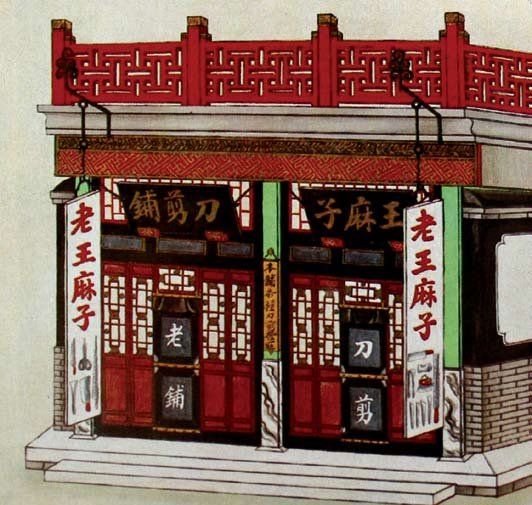
In China, shop signs are of two major categories: one is signboard o which the name of the shop is given; the other is trade sign, giving the line of business. The sign board is usually in the shape of an oblong wooden board and the trade sign often gives the commodity to be sold or items or services by means of images.
Not until the Song Dynasty, shop signs were used chiefly in restaurants and teahouses, and then drugstores, draperies, pawnshops, medicated plaster shops, hotels, tobacconists, etc. started to have a piece of cloth hanging in front of the door showing trade signs. The masterpiece Pure Brightness Day on the River displays a prosperous and noisy scene of the streets in the capital, with rows and rows of stores carrying shop signs of various types clearly seen.
When it came to the Ming and Qing dynasties, shop signs became numerous in variety following the blooming of market-place commerce, which fall largely into four categories: image sign, written sign, material object sign and symbol sign.
The image sign refers to the models of the commodities sold in the shop. In a tobacconist, an enlarged tobacco leaf and a tobacco pouch were drawn on a piece of cloth or a wooden board; in a shoe store, a model of the sole of a shoe was hanging up.
Address: Liaoning Province, Shenyang City, Heping District, Shiwei Road, #26
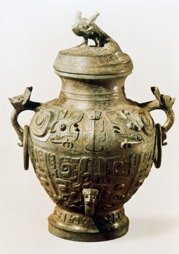
A Western Zhou dynasty bronze utensil- a lei (a kind of ancient wine vessel) with a lid and coiling dragons pattern
The Liaoning Provincial Museum is located in Heping District of Shenyang City, Liaoning Province. The area of the Museum grounds and buildings totals 110,000 square meters. The heart of the Museum is a three-story exhibition hall that was designed by a German architect. In 1988, a new threestory white building was built inside the grounds that includes a large hall and a surrounding corridor.
Historical artifacts and ancient arts are the main focus of the Museum’s collections. These include
some eighteen categories of objects: paintings and calligraphy, embroideries, woodblock prints, bronzes, ceramics, lacquerware, carvings, oracle bones, celadons, costumes, archaeological material, coins and currency, stelaes, old maps, ethnic minority artifacts, revolutionary artifacts, furniture, and assorted other items. Among these some were excavated and others were passed down through the ages, that is inherited, not recovered from the earth. The collections occupy an important position among museums’ collections in China.
Painting and calligraphy collections include paintings by famous Tang-dynasty and Northern Song artists, and
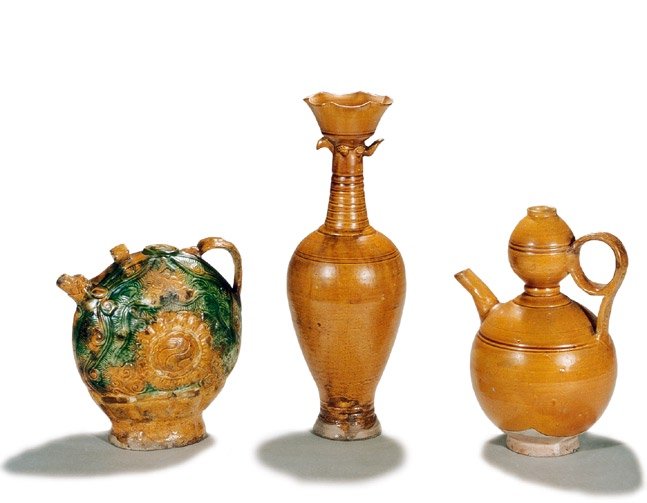
Liao ceramics collected by the Liaoning Provinceial Museum
woodblock-print editions include the Ming-dynasty Album of the Ten-bamboo Studio, the first colored woodblock print in Chinese woodblock-print history.
The ceramics collections in the museum are also quite famous and valuable. Liao porcelain is unique in the art form for its treatment of colored glazes, but the collection also includes Liao monochromes such as the lovely Liao white porcelain. Many of the ceramic forms embody nomadic characteristics, and the glazes and colors are imbued with local character. Production methods continue the traditions of the Tang and Five dynasties kilns.
Two permanent collections are on display in the museum. One is an exhibit on Chinese history, and the other is a display of stone inscriptions. The former deals with overall Chinese history in general but also takes local Liao history into special consideration. Contents include:
Room 1: The main archaeological findings from Paleolithic and Neolithic times in the Liaoning region. Key emphases are on the sites from early Paleolithic times at Yingkou Jinniu Shan, the Paleolithic cave site at Hezi Cave, the Hongshan Culture site, the Shenyang Xinle early Neolithic site, the Lushun Guojia Cun site, and so on.
Room 2: Key exhibits include a Xiajiadian Lower-level-culture site that corresponds to Xia and Shang periods that was discovered in Liaoning, several sites that have produced Shang and Zhou bronzes, and bronze daggers and swords that accom-panied burials, etc.
Rooms 3 and 4: Show items from the period of Warring States, Qin, and Han.
Rooms 5, 6, and 7: Show items from the Three Kingdoms, the East and West Jin, the North and South dynasties. Most importantly, on exhibit here are the tomb wall paintings of Liaoyang.
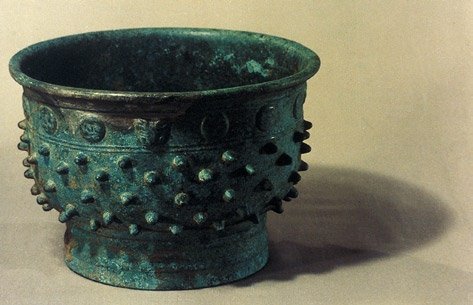
A copper gui called ‘yufu gui,’ a kind of food vessel used in the Western Zhou dynasty unearthed in Kazuo, Liaoning
Room 8: Is the exhibition hall for Sui, Tang, and the Five dynasties. The main objects on display were excavated from a Tang-dynasty grave discovered in Chaoyang, also a group of artifacts from the Bohai Kingdom, which include a group of rarely seen earthen statues.
Rooms 9 to 12: Are exhibitions for Liao, Song, Jin, and Western Xia. A key emphasis is the exhibition of items from some extraordinary Liao tombs. Also on display is a farmer’s house site from the Jin dynasty, as well as Liao, Song, and Jin ceramics.
Rooms 13 to 18: Exhibit Yuan, Ming and Qing objects. These include Ming-dynasty maps, an inscription from a military commander of the Ming, from eastern Liaoning, also Ming and Qing dynasty ceramics and paintings.
Address: Jiangsu Province, Nanjing City, Zhongshan East Road, #321 The Nanjing Museum is located inside the Zhongshan Gate of Nanjing City. Its predecessor was known as the Central Museum Preparatory Location. The complex of buildings represents an amalgamation of east and west, with the great hall copying the style of a Liao-dynasty palace. The Museum … Read more