Ivory Carving

Shang Dynasty ivory carving kuipan (dragon-like monopode animal) cup unearthed from the Fuhao tomb at Yin Ruins, Anyang, Henan, Housed in the National Museum of China

Early in the Neolithic Age, the Chinese ancients already started to use articles made of bones, fangs, and
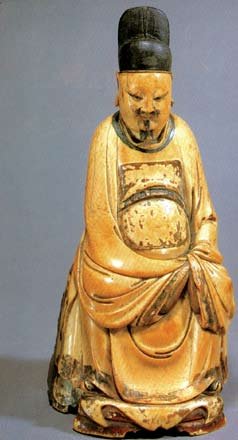
Ming Dynasty ivory carving, human figure, 20 cm high, housed in Shanghai Museum

horns from animals along with stoneware, wooden articles and pottery ware. Materials for carving taken from animals are mostly ivory. The animal-mask patterned ivory cup inlaid with pine-and-stone design unearthed from the Fuhao Tomb in the Yin Ruins, Henan in 1976 can be called a representative of the Shang Dynasty ivory carving.

The ivory carving craft made rapid progress in the Song Dynasty, marked by the multi-cased ivory ball named “Superlative Workmanship” using fretwork process completed by the royal handicraft workshop. On the surface of the ball relief patterns are engraved; inside the ball are several hollow balls with different size one on top of the other. Each ball is engraved with exquisite and complicated designs, appearing delicate and refined.

In the Ming and Qing dynasties, economic and cultural exchanges with South Asia and Africa promoted. Ivory material was introduced to China. Then the ivory carving art entered a period of full bloom.

In the Ming Dynasty, invory carving was mainly done in Beijing, Yangzhou and Guangzhou, and widely involved by the government, folk artisans, men of letters and refined scholars. Ivory artworks an other small-sized carved articles using bamboo, wood, gold, stone, etc. became rare curios and ornaments. At that time ivory and rhinoceros horn carvings made no difference to bamboo, wood, gold or stone carving so far as carving skills were concerned. Quite a number of craftsmen had no difficulty in carving using different materials, some were known as all-arounders in carving.

In addition to the common techniques such as single-line intaglio carving, round carving, relief carving, micro-carving, etc., there are three more unique skills in Chinese ivory carving: fretwork, cleaving-plaiting and inlaying-dying.
Read more

Glassware

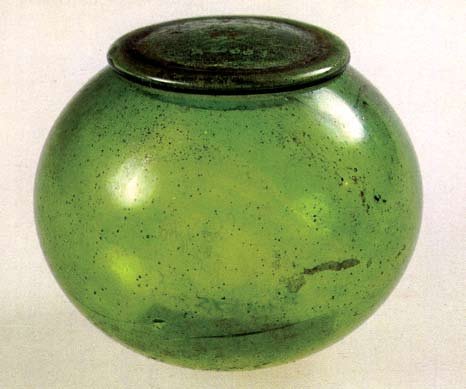
Sui Dynasty covered pot made of green glass.

Glassware containing lead and barium emerged as early as the Western Zhou Dynasty. The lead-barium glass requires a relatively low melting temperature. It looks sparkling and crystal clear, but thin and brittle, and can not resist sharp drop or rise in temperature. It is therefore unfit for making utensils or apparatuses. Often lead-barium glass was processed to make ornaments, ritual objects or funerary objects.

By the beginning of the Warring States Period, dragonfly-eye and jade-imitation glass was invented. Dragonfly-eye glass is prepared by adhering multicolor rings on top of glass beads, looking like dragonfly-eyes, thus the name. in the Spring and Autumn and Warring States Period, glass techniques became mature and technical exchange with foreign country started. The technical process in making glass includes casting, twining, inlaying, etc. glass objects such as bi (a round piece of jade with a hole in its center used for ceremonial purposes in ancient China), ring and sword are prepared by pouring melted glass into moulds.

Read more

Arts and Crafts during the Song, Liao, Jin and Yuan Dynasties

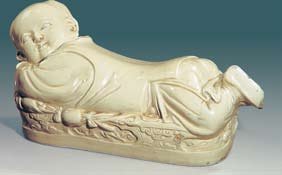
A porcelain pillow from the Dingyao Kiln of the Song Dynasty, a piece of rare ancient porcelain exquisitely made in the shape of a vivacious kid.

As the handicraft level of the Song Dynasty was rather high, obvious development was made in various aspects, such as the development of varieties, the scale of production, the technology of handicrafts, the management and trading. The administrative setups of government-run handicrafts were more unwieldy and the division of labor was more elaborate than the Tang Dynasty. Most of the artisans of the government-run handicraft were recruited and had personal freedom to a certain extent while the management of the folk handicraft workshop was even more flexible and open. The commerce of the Song Dynasty was well developed, the urban economy became brisk day by day and handicrafts became commodity production universally. In Bianliang (the capital of the Northern Song Dynasty in the present Kaifeng, Henan) and Lin’an (the capital of the Southern Song Dynasty in the present Hangzhou, Zhejiang) shops and stores stood in great numbers, gathering together almost all articles of daily use, and urban handicrafts were very flourishing, The scroll of the Qingming Shanghe Tu (Pure Brightness Day on the River) drawn by Zhang Zeduan(1085-1145) of the Northern Song Dynasty showed the busy commercial activities in Bianliang city in a lively and visual representation. There was regular country fair on the outskirts of bi cities like Chang’an, Luoyang, Fuzhou, Quanzhou, Yangzhou and Chengdu. Gradually the rural fairs developed into marked towns.

The Song Dynasty deserved the title of the “Porcelain Age” as porcelain was the most outstading of all its handicrafts. Famous kilns were scattered from north to south. The Dingyao Kiln, Ruyao Kiln, Guanyao Kiln, Geyao Kiln an Junyao Kiln were known as the five famous kilns of the Song Dynasty. They created ceramic varieties with their respective characteristics, such as the white porcelain of the Dingyao Kiln, the celadon of the Ruyao Kiln, the light greenish blue porcelain of the Guanyao Kiln, the crackle porcelain of the Geyao Kiln, the transmutation porcelain of the Junyao Kiln and the shadowy blue porcelain of the Jingdezhengyao Kiln. In addition, the simple and straightforward porcelain fired by folk kilns like the Cizhouyao Kiln in the north and the Jizhouyao Kiln in the south was verypopular among the people. The ceramic technology of the Song Dynasty achieved unprecedented prosperity by incorporation the great achievements of the successive dynasties. The dyeing and weaving technology of the Song Dynasty was also greatly developed. The varieties of silk weaving were plentiful and the center of silk weaving was in the regions south of the Yangtze River. For the production of lacquer ware, not only did the government have special administrative setups, the fabrication among folk people was also so common that local centers were formed. For the jade carving technique, as the “qiao se” (coincidental natural colors) on the jade was given full play to, gigantic achievements were obtained.

Read more