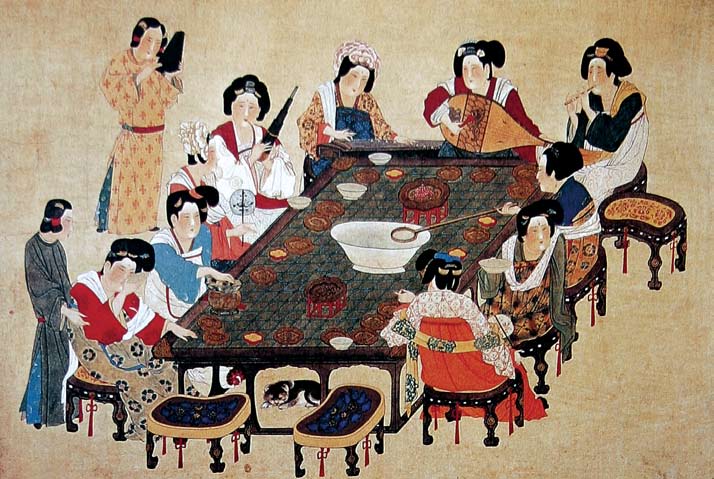
 Furniture is closely related to people’s life-style and environment. The sitting posture of the Chinese people has changed from sitting on the floor as in ancient times to sitting on a seat as in present day. The shape of furniture falls accordingly into two series, the low-type and the high-type to suit people’s needs at respective historical stages.
From the Shang and Zhou down to the Han and Wei dynasties, people used to sit on the floor or take a half-kneeling, half-sitting position. The limited pieces of furniture available at that time such as narrow oblong tables and side tables were all low and short, which could be moved about without being placed in fixed position. In the Three Kingdom Period, a high-type seat Hu-chuang (literally bed from non Han areas), similar to present-day campstool, was introduced for the first time to Han people from the minority nationalities region. As time went by, higher articles for home use such as round stools, square stools started to appear in the Central Plain area. Beds, couches, etc. also became higher gradually, though low furniture still took a dominant position. Starting from the Western Jin Dynasty, the concept of half-sitting, half-kneeling posture as was required by etiquette, gradually faded. People either sat on the floor with legs stretched out, or sat cross-legged, or sat aslant, just as they pleased. And then the side-table was created which was placed on the bed for leaning against or leaning back, together with yinnang, something like a modern back-cushion.