Qiu Changchun, the forefather of Jade Carving in Beijing

Qiu Chuji, also known as Taoist Changchun, was the earliest ancestor of jade trade in Beijing and was called Ancestor Qiu by artisans. As the end of the Southern Song Dynasty, Ancestor Qiu was born in a town in Shangdong and his family financial situation was poverty-stricken. Not far away from his home, there was … Read more

Bronze Ware

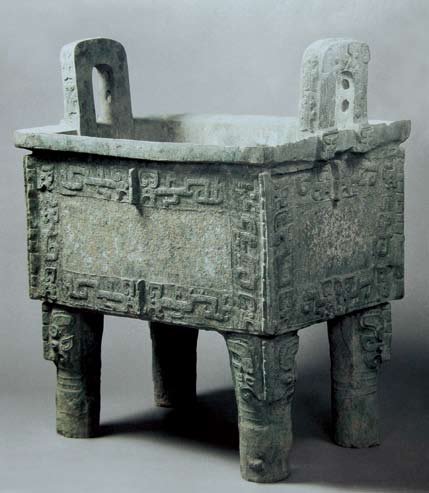
Grand Simuwu quadripod of the late Shang Dynasty, housed in National Museum of China

The arising of bronze ware in China goes back to an early age. A bronze sword made by single mould 5,000 years ago unearthed at the site of Majiayao in Gansu Province, is to date the earliest bronze object discovered. For several thousand years, Chinese craftsmen have mastered superb techniques in bronze ware manufacturing to form unique style as regards the technological process, mould-making and decorative patterns.

During the late years of Neolithic Age, some archaeological culture had entered a time when both bronze and stone were used, which created prerequisite conditions for the development of broze ware. The artistic factors of bronze ware can be traced in the stone artistic factors of bronze ware can be traced in the stone artifacts, pottery and jade articles made in the late years of Neolithic Age. For example, shapes of bronze implements and weapons originated mostly from stone ware, whereas the shaping of bronze vessels was inherited from pottery mould-making. Form bronze tripods, caldrons and goblets you can find their respective prototype. And such is the case with decorative patterns on bronze ware. Take the distinguished taotie (a rapacious animal in Chinese mythology) pattern, a common decorative pattern on ancient Chinese bronze ware, for an instance. Its source can be traced back to the jade articles in the Longshan Culture in the Neolithic Age. The Erlitou Culture that came between Longshan Culture and Shang Culture ad already entered the Bronze Age. The bronze ware found in Erlitou, in addition to tools, weapons and aricles for personal adornments, includes vessels made with double-mould and the noticeable turquoise-inlaid technique.
Read more

Lacquer

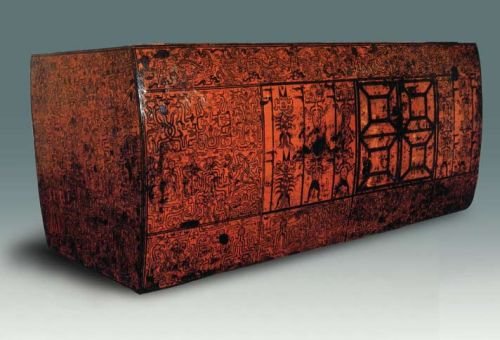
Painted lacquer inner coffin made in early Warring States Period, unearthed from Zenghouyi tomb in Suizhou, Hubei, kept in Hubei Museum

Lacquer ware is a sort of artifacts using wood or other materials as body on which lacquer is coated. Chinese lacquer-painted woodenbowl discovered in the Hemudu remains in Yuyao, Zhejiang Province in 1978, which went back 7,000 years.

In the Neolithic Age, lacquer was still at an exploring stage. From the Xia, Shang and Western Zhou dynasties down to the Spring and Autumn Period, lacquer ware had experienced its initial prosperous period. During the warring states period and han dynasty, tree cultivation started to be taken seriously, conducive to lacquer production on a grand scale which lasted for centuries. The classic historical records writes that Chuang-tzu (c.369-286 B.C.), the great philosopher was once an official administration was established to take charge of lacquer production, which was managed under strict organization with elaborate division of labor. The inscriptions on Han Dynasty lacquer utensils excavated in Rakrang of Korea in 1932 tell in detail the date, location, division of work and names of officials involved in the manufacturing. According to the record, division of labor was clear and definite, in which lacquer body preparing, lacquer coating, painting, bronze buckle fixing, finishing, etc., each was done by specific craftsmen. In addition, there were workers specialized in making lacquer, providing materials, etc.

In the early Warring States Period, lacquer ware body was made of wood, which is thick and heavy. Later on, other materials (gray ash generated from the sumac reinforced with flax fibers), tough oxhide, etc. The state of Chu was the hub of lacquer production at that time where the articles made were red and black in color, mostly red patterns painted on black background with primitive simplicity. Animal patterns, geometric figures, and patterns reflecting social life such as chariot and horse, dancing, hunting, etc. were used for decoration. Already were products rich in variety, to be used not only as utensils, stationery, ornaments for furniture, but also for musical instruments, weapons and funerary objects, partly in place of bronze ware. They were therefore much favored by dukes and princes in spite of their high price.

Read more