The legend of Brother Kilns

Brother Kilns- the two brothers, Zhang Shengyi and Zhang Sheng'er, worked hard to improve celadon technology
Brother Kilns- the two brothers, Zhang Shengyi and Zhang Sheng’er, worked hard to improve celadon technology

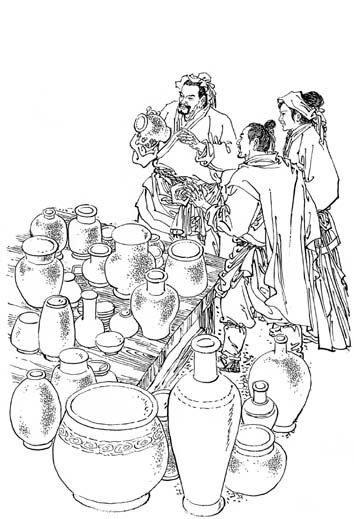
The longquan celadon is one of the notable varieties of the traditional ceramics of China. This legend was about how two brothers, Zhang Shengyi and Zhang Sheng’er, of Longquan County, Zhejiang, in the Southern Song Dynasty improved celadon. The legend has it that the Zhang family was engaged in porcelain-making from generation to generation. According to their father’s last wish, the two brothers ran their respective kiln and tried hard to make innovation.

Beginning with colors, Zhang Sheng’er analyzed seriously all the colors man could see in the sky and on the earth and came to the conclusion that cyan was the basis of all colors, the essence of all colors and the most beautiful color, as it pleased both the eye and the mind. After discussion, the two brothers decided to take cyan as the fixed color of the Zhang family to make porcelain. When he happened to see a green plum tree standing gracefully erect by the kiln shed, Zhang Sheng’er thought the cyan of plums, he had them simmered into thick juice, blended it into glaze and applied it onto the porcelain base. Finally celadon, which was bluish, came into being and caused a great sensation. After seeing it, Emperor Gaozong (1127-1131) of the Southern Song Dynasty was so delighted with it that he could hardly bear to put it down on seeing it and issued the imperial decree to change the porcelain kiln of Zhang Sheng’er into a government-run porcelain industry and conferred the title of the “Diyao Kiln” (The Younger Brother’s Kiln) upon it.

Zhang Shengyi also cherished high ambitions in his life, trying to burn out a kind of crackle porcelain, which had always been believed to be something bestowed by deities, as an artifact. In order to be disclose the secret of porcelain crackling, he kept to himself and never got married. After serious studies and investigations, he found that for gaining a few pieces of crackle porcelain the people of his time often threw a living person into the blazing kiln. The blood and moisture of the living person caused the crackling of the porcelain. When blood congealed, the color was purple. That is why the color o crackle porcelain was always of a little blood red. Besides, when the porcelain base came across moisture, there was no time for it to shrink and hence crackling in polygonal shape. As Longquan was available with a special kind of clay with the color of a little blood red, the key issue was moisture and the right amoun of water injection. Zhang Shengyi persisted in doing contrast test but failed again and again.
Read more

Silk Weaving

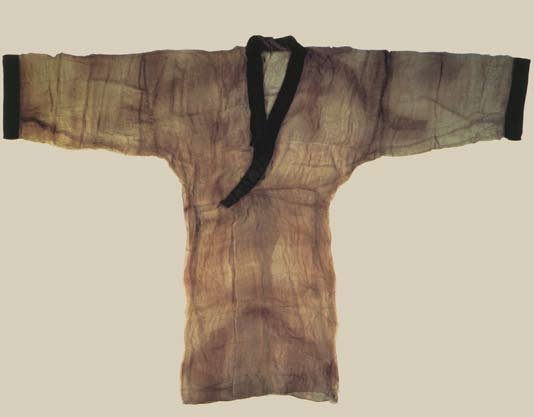
Monk's plain-gauze robe unearthed from Han-tombs at Mawangdui, Changsha, Hu'nan Province. It is made of highly fine natural silk, manifesting that Chinese silk weaving was already elaborate in workingmanship at that time.
Monk’s plain-gauze robe unearthed from Han-tombs at Mawangdui, Changsha, Hu’nan Province. It is made of highly fine natural silk, manifesting that Chinese silk weaving was already elaborate in workingmanship at that time.

The Chinese silk weaving is well known in the world for its long history, advanced crafts and fine workmanship. Silk fabrics in ancient times include the following varieties: juan(thin, tough silk), sha (gauze as a general term), qi (damast), luo (silk gauze), jin (brocade), duan (satin), kesi (brocade woven using a special craft).

In the Shang Dynasty, silk fabric with conspicuous twisting warp weave ad already emerged. When it came to the Western Zhou Dynasty, more complicated brocade-weaving craft was developed. Down to the Spring and Autumn and Warring States Period, silk-weaving had attained a rather high level. Silk fabrics cover juan, luo, sha, and jin; the designs include rhombus pattern, S-shape pattern, and geometric patterns adorned with dragon, phoenix, human figure, etc. Silk weaving and knitting in the Qin and Han dynasties, Han in particular, made a leap forward on the basis of the Warring States Period tradition, containing more varied silk fabrics such as jin, ling (twill-weave silk), qi, luo, sha, juan, gao (thin and white silk), wan (fine silk fabrics), etc. The common designs on silk fabrics in the Han Dynasty include floating clouds, animals, flowers and plants, auspicious characters, and all sorts of geometric figures. The art of silk-weaving in the Han Dynasty was already elaborate, in particular in the weaving of single-thread gauze with even distributed meshes, of which the representative work is a plain gauzed Buddhist monk’s robe unearthed from the Han Tomb No.1 of Mawangdui in Changsha, Hu’nan Province. It measures 128 centimeters across from one end to the other end of the two sleeves, 190 centimeters long and yet weighs only 49 grams. Extremely marvelous.

Silk weaving in the Tang Dynasty was meticulous in the division of work. The Weaving and Dyeing Administration under

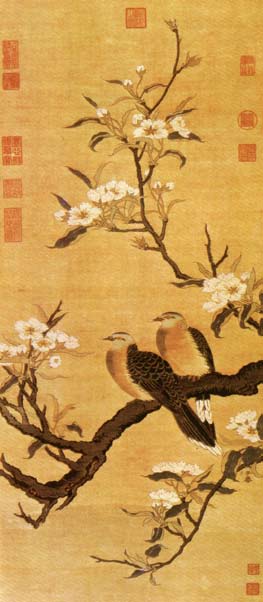
Work of Shen Zifan, kesi silk weaving craftsman of Southern Song Dynasty, meticulously depicting the serene and realistic style of flower-and-bird painting of Southern Song Dynasty.

the central government had been set up to take charge of production, while private silk-weaving business could be found all over the country, producing large quantity of fabrics. Craftspeople at that time did their utmost to seek gorgeous coloring effect. Among the multiple varieties, brocade was the best-known, called “Tang brocade.” As is different from traditional craft in which warp was used to weave decorative patterns, Tang brocade-weaving, affected by the Western Region textile culture, used weft to form decorative patterns sandwiched between warp weave. It was called “weft brocade.” The loom used for weft brocade by which decorative patterns are formed with multi-layer and multi-colored weft, is complicated in structure but easy to handle, capable of weaving more complex designs and broad fabrics. Since the middle period of Tang Dynasty, using weft to form decorative patterns had become the mainstream in silk jacquard weave. The Tang brocade, which assimilated exotic ornamental patterns, manifested a fresh, resplendent and imposing style. Aside from Tang brocade, ling (silk fabric with twill weave as basic characteristic) was also very popular, in particular the lian-ling manufactured in Zhejiang Province, which was best known at that time. Dou Shilun, best reputed silk pattern designer, usually took subject matters like sheep, horse, dragon, phoenix, etc. for decorative patterns. As what he designed often appear original, unconventional, and full of vitality, they were called “Duke of Lingyang patterns,” as he was ever made Duke of Lingyang by the emperor.

Read more

Arts and Crafts during the Spring and Autumn Period and the Warring States Period

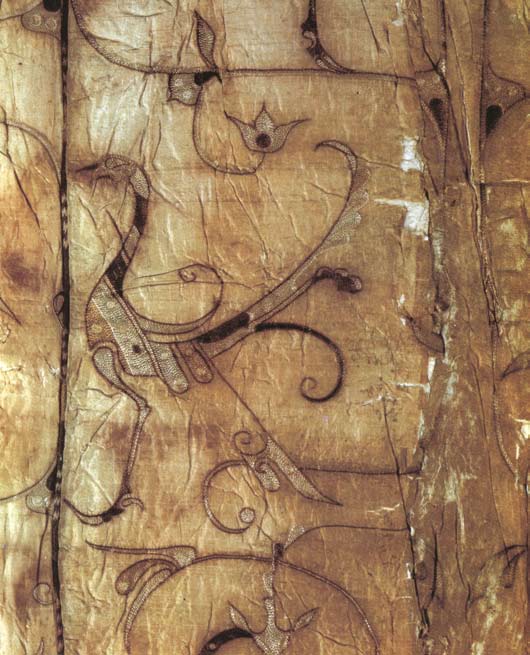
Light yellow thin silk quilt with line embroidery of phoenixes and dragons in pairs from the Warring States Period (partial)

During the Spring and Autumn Period and the Warring States Period, with the integration of the slave system and the gradual establishment and development of the feudal system, handicraftsmen got rid of the slavery of the slavery of the slave system, their enthusiasm for production obtained greater development. At this period many handicraft articles with exquisite workmanship, beautiful shape and unique creativeness appeared in the field of arts and crafts, such as metallurgy, ceramics, dyeing and weaving and lacquer ware.

During the Warring States Period, iron-smelting industry came into being on the basis of copper metallurgy and China took the lead in the world to enter upon the Iron Age in an all-around way. There were a great many pottery-making workshops run by the government or by self-employed artisans, all giving first place to gray pottery. Due to the prevalence of elaborate funeral, painted pottery was rapidly developed. As lacquer ware was anticorrosive, moisture-proof, light in weight and good-looking in appearance, its technology also began to develop. The lacquer ware produced in the Kingdom of Chu was the most developed. Due to the development of iron smelting, the improvement of pottery-making and the appearance of lacquer ware, bronze ware stepped into a later stage and was gradually replaced by lacquer ware. The dying and weaving technology and production were widely distributed and the most developed areas were in Qi (the present northern Shangdong) and Lu (the present southern Shangdong). Knee-deep clothes and hufu(short clothes worn by non-Han nationalities living in the north and west in ancient times) were not mutually exclusive. Knee-deep clothing was a kind of garment with the lower part and the lower hem was edged but not slit in the sides. It was the main fashion of that time, continuing up to the Han Dynasty. The hufu was originally worn by the nomadic people on the grasslands in the north, having the characteristics of jacket, trousers and boots. Later it was introduced into the Central Plains, improving combat effectiveness and bringing about convenience to life.

Read more