Gold and silver ware

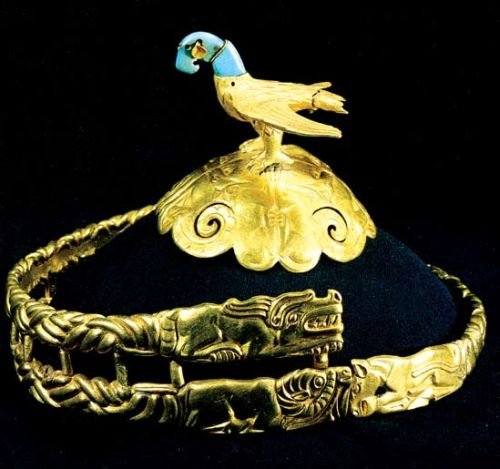
Eagle decorated golden crown top and golden crown belt of the Warring States Period.

The major methods for processing fold articles originated from bronze making, which include smelting, mould founding, hammering, welding, bead-forming, engraving, wire-twining, wire inlay, etc., but developed or innovated. Take the bead-forming craft for example. It is an art unique to gold processing in which the first step is to let melted gold drip into warm water drop by drop to form beads of various sizes, and then by welding each tiny drop of gold, fish-egg patterns or bead-string patterns are made. Silverware turned up later than gold, and followed gold articles in working procedures.

From the very beginning gold and silver articles came out as artworks. The existing earliest gold objects were made in the Shang Dynasty more than 3,000 years ago. They were mostly ornaments, simple in shape, small in size, with less decorative patterns. The Shang-dynasty gold articles were chiefly gold and silver foil, gold leaves and sheets, used to adorn utensils; only a few in the northern and northwestern regions were used for personal adornment. Of the earlier gold articles, the gold masks and the gold staffs unearthed from the early Shu-culture ruins in Sanxingdui of Guanghan, Sichuan Province, are the most eye-catching. In the Shang and Zhou dynasties, the bronze techniques and the jade carving both facilitated the growth of gold and silver crafts.
Read more

Arts and Crafts during the Six Dynasties

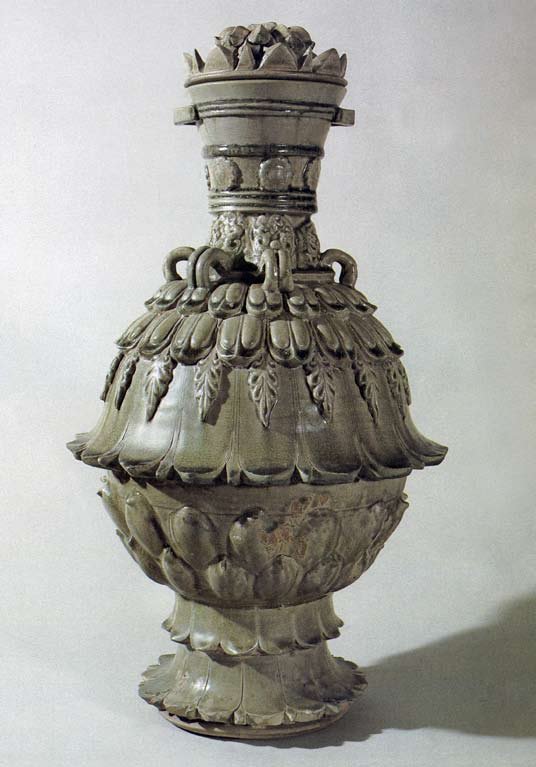
Celadon zun (a kind of wine vessel) in lotus shape from the Northern Dynasty with gorgeous pattern and well-rounded shape, a representative work of northern celadon

During the period of the Six Dynasties, wars occurred frequently in the north but the south was comparatively stable. The shifting of a large number of population and technical strength to the south promoted the exploitation and development of the south. The situation of taking the north as the center of economy and handicraft production for a long time began to change and a new situation was formed for the whole nation to develop in a balanced way.

The Six Dynasties, inheriting upward from the Western Han Dynasty and the Eastern Han Dynasty and handing down to the Sui Dynasty and the Tang Dynasty, was an important transitional period in the handicraft history of China. The turbulence of the society, the sufferings brought about by the war, and he mental agony gave an opportunity to the rise and dissemination of Buddhism to publicize karma and samsara and the rulers also made use of Buddhism to consolidate their rule. As a result, Buddhism was energetically encouraged. In the north, grottoes in Dunhuang, the Datong Grottoes, and the Luoyang Grottoes are all the pioneering works left from that time. In the south, Buddhism. Many a brass or copper ware, gold vessel, silverware, carved stone, textile, embroidery and lacquer ware all contained the subject of Buddhism. Lotus and honeysuckle, the main ornament at that time, became the symbols of Buddhism. The prevalence of Buddhism also contributed to and expanded international exchanges. The visit of monks from India and craftsmen from the Western Regions introduced the Indian art compromising the Greek and Persian styles to China and impelled the handicraft culture of China to carry out a new synthesis. Therefore, the religious trend and foreign style of the industrial art are the important handicraft features of the Six Dynasties.

Read more

Gourd-shaped porcelain canteen and the Yue’s Troops

At the end of the Southern Song Dynasty, there was a kiln artisan named Hulu at the Cizhouyao Kiln. He was clever and skillful. Once he made a kind of porcelain canteen, thick at both ends but thin in the center, convenient to carry. As it looked exactly like the gourd used by immortals in … Read more