Ningxia Hui Autonomous Region Museum

Address: Ningxia Hui Autonomous Region, Yinchuan City, Jingning Street, #2
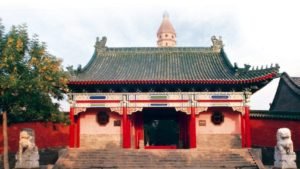
The exterior of the Ningxia Hui Autonomous Region Museum

The Ningxia Hui Autonomous Region Museum is in the capital of the region, Yinchuan city, in the old city district. It is located in the grounds of the Chengtian Temple and uses the main building of the temple as its central hall.
This was built in traditional manner in 1988 on the foundations of a Qing dynasty building; the rest of the buildings are auxiliary halls also built around 1988. Behind these ‘front-court’ buildings is a courtyard-style building built in the Qing dynasty. The institution is a comprehensive-style museum that brings together Ningxia historical artifacts, items of people’s customs, and art collections that have been passed down through the ages.

Ningxia Historical Artifacts Exhibition
This focuses on articles from local history, from ancient times up to Ming and Qing. It is divided into sections as follows: primitive society, Shang and Zhou,Qin and Han, Sui and Tang, Song and Yuan, Ming and Qing, and mostly displays items that have been passed down through generations. Objects of natural-history interest include fossilized paleontological material. Early archaeological material includes ceramics of the Majiayao culture, and artifacts from all the dynastic periods of China that represent the border regions cultures. From ancient times, the Ningxia region has been a confluence of cultures, a place where many different nationalities and peoples came together. It displays in particular the interaction of people from border regions and people of the central plains. The Ningxia historical exhibitions provide tangible evidence of this rich history.

Read more

Guangxi Zhuang Autonomous Region Museum

Address: Guangxi Zhuang Autonomous Region, Nanning City, National Minority Dajie, #34

A jade cup of the Western Han dynasty

This museum was established in 1978 on the east side of the People’s Square in Nanning City and in 1988 a new People’s Cultural Hall was added to it. The entire Museum occupies 56,757 square meters of space with a building space of 22,761 square meters. The exhibition building is a modern structure with southern architectural characteristics, which contains six exhibition halls.

The ‘Guangxi Historical Artifacts Exhibition’ exhibits all periods of Guangxi history from Primitive Society up to the Opium War (1840-1842), reflecting local culture and the interchange with the Central Plains and neighboring regions and the process of cultural melding and development. The exhibition of the ‘Liujiang Man’ shows the earliest hominid fossil found to date within the borders of Guangxi. It belongs to the late period of hominids and is the earliest representative of modern man found to date not only inside China but in all of the Southeast Asia region.

Stone tools manufactured in more than one hundred sites have been found in Guangxi. Mesolithic-period polishedblade stone tools and stones with finely wrought holes in them are displayed in the museum, as well as a wealth of artifacts from the Neolithic period. Neolithic sites are divided into three main types, those in caves, on hills, and on mountain slopes and artifacts are exhibited from all three. Of particular note is a large ceremonial shovel-shaped object that is 66.4 cm in length and 44.8 cm wide. The quality of its manufacture, its size, and its polishing make it a superlative work.

Copper phoenix lamps of the Han dynasty unearthed in Hepu, Guangxi. The necks can be turned or taken apart in order to adjust light and clean the ashes in lamp bodies.

In the Shang and Zhou periods, two tribes who lived in Guangxi began to have political, economic and cultural relations with the Central Plains region. Certain bronze items are evidence of this cultural interchange although there is also evidence that 2,500 years ago, during the late Western Zhou period, Guangxi’s ancient inhabitants were creating their own brilliant bronze culture. Items in the Museum that demonstrate this culture include spears, axes, ladles, bells, and many other items found the ‘Matou Yuanlongpo’ grave in Wuming County. Early inhabitants also achieved a high level of ceramic technology, with firing temperatures of 1150 degrees centigrade. Many such ceramics are on display in the Museum.

Read more