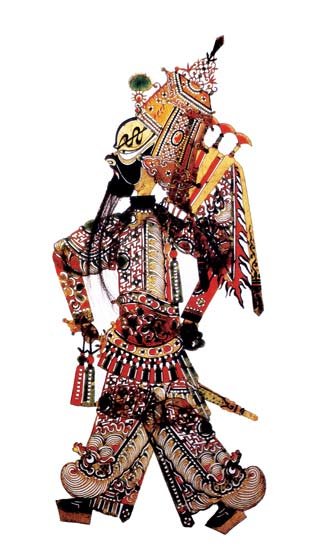
Shadow play is a popular folk opera belonging in the category of puppy show in which performers use leather or cardboard silhouettes to enact plays. A light is shone onto a screen, behind which performers operate the silhouettes while singing to the company of music. It is a form of art unique to China where folk arts and crafts are ingeniously combined with theatrical performance.
Silhouettes are similar to paper-cuts, but differ in that the hands and legs are joined with string so that they are movable. The silhouette figures were cut from cardboard ar first and from donkey hide or ox-hide, sheep-hide, etc. later on. Usually a piece of hide is cut, colored, ironed and joined into a figure with nimble limbs. The tools used in making silhouette figures are rather particular about, which include five categories: knives, blades, files, drills, and prods, for shaping the head, trunk, legs hands and feet respectively.
The silhouette figures, vivid in shape and rich in color, are projected onto a screen. In a performance, the operator, while singing to the accompaniment of music, manipulates the figures as the story of the play
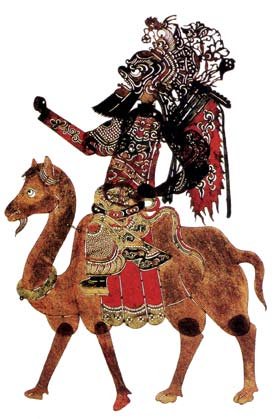
requires. To adapt to the form of screen expression, the skill of combining abstractness and reality is applied in shadow play in which scenes are made artistic, exaggerate and dramatic. Aside from screen presentation, silhouette figures can be played on window sills as ornaments. They can be appreciated or kept as collectables.
Shadow play can be traced back to the Western Han Dynasty. Legend has it that in the region of Emperor Wen (203-157 B.C.), a court lady who was playing with the crown prince in front of the window, had human figures cut from Chinese parasol leaves, which she managed to reflect on the gauze windows for fun. That is the origin of shadow play. Actually shadow play in China started from the Northern Song Dynasty and gradually prospered. According to dream of the Eastern Capital written by Meng Yuanlao in Song Dynasty, in the capital city of Lin’an (now Hangzhou), a shadow play troupe named “Painted-Leather Society” was established. In the third year of Zhengde under the reign of Emperor Renzong in the Ming Dynasty, a hundred-drama festival was held in Beijing in which performances were also given by shadow play operators. In the Qing Dynasty, shadow play further developed and became popular, with more items on the program to choose from, more varieties of figures, and more meticulous in the carving skills. During the reign of Emperor Jiaqing (1786-1820), the shadow play troupes also gave performances for home celebration on New Year Day and other festivals. At that time, quite a few Peking opera actors joined in the performance of shadow play. Since the mid-Qing Dynasty, types of facial makeup such as sheng (male role), dan (female role), jing (painted-face role), mo (elderly male role) and chou (role of clown) appeared in shadow play, as learned from Peking Opera.