Henan Museum

Address: Henan Province, Zhengzhou City, Nongye Road, #8 The Henan Museum is one of China’s oldest museums. It is a ‘key’ museum, with modern displays and exhibitions, modernized equipment, and a unique architecture. In 1961, along with the move of the provincial capital to Zhengzhou, it moved to its current location. In 1991 that museum … Read more

Kite

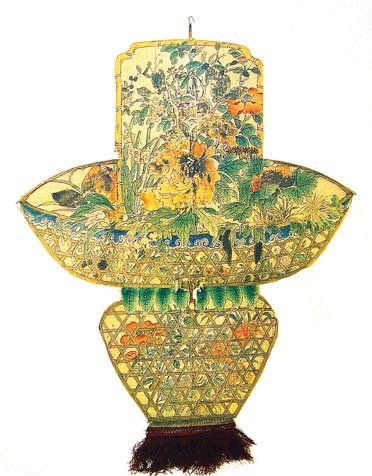
Flower-basket kite made from juan-silk and bamboo in Weifang, Shangdong

Kite is one of the most typical Chinese folk toys. It incorporates into a whole appreciation, entertainment, competition, exercise, and is closely connected with folkways, festivals, science and technology, history, etc., fully revealing the rich content of folk toys. Flying kites often occurs on the occasion when people go for an outing around the Pure Brightness Day. In the past people used to write their own names on the kite when they were in distress of fell ill. As the kite was flying high above, they cut the string and let the kite fly away with the wind. In so doing they believed that their bad luck had gone with the kite.

The name of kite varied in different period of times. Some ancient book written in the pre-Qin period records that the thinker Mo-tzu and the master craftsman Gongshu Ban had both made something called “wooden hawk.” Later on it was said that the distinguished general Han Xin (?-196 B.C.) ever made “paper hawks” in the first years of Han Dynasty. According to more reliable source, the kite originated in the Northern and Southern Dynasties. It was named “paper crow” or “paper owl” at that time. The kite was not used as a toy but used in military affairs, correspondence, measurement, publicity, etc. It was after the Five Dynasties that the kite became popular and turned to be a means of entertainment. During the mid-Tang Dynasty, paper started to be more widely used in everyday life and gradually replaced other more expensive materials in making kite thanks to its low cost and easy working process.

By the Song Dynasty, kite-flying was popularized; kite-making became an occupation. Gradually the custom of flying kites at the Pure Brightness Festival was established. Scenes of flying-kite can be seen in both the famous painting Pure Brightness Day on the River by Zhang Zeduan, eminent artist of the Northern Song Dynasty and the picture One Hundred Sub-graphs by Su Hanchen.

Read more

Ivory Carving

Shang Dynasty ivory carving kuipan (dragon-like monopode animal) cup unearthed from the Fuhao tomb at Yin Ruins, Anyang, Henan, Housed in the National Museum of China

Early in the Neolithic Age, the Chinese ancients already started to use articles made of bones, fangs, and

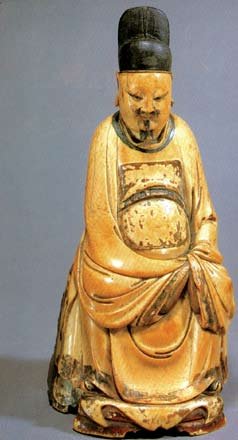
Ming Dynasty ivory carving, human figure, 20 cm high, housed in Shanghai Museum

horns from animals along with stoneware, wooden articles and pottery ware. Materials for carving taken from animals are mostly ivory. The animal-mask patterned ivory cup inlaid with pine-and-stone design unearthed from the Fuhao Tomb in the Yin Ruins, Henan in 1976 can be called a representative of the Shang Dynasty ivory carving.

The ivory carving craft made rapid progress in the Song Dynasty, marked by the multi-cased ivory ball named “Superlative Workmanship” using fretwork process completed by the royal handicraft workshop. On the surface of the ball relief patterns are engraved; inside the ball are several hollow balls with different size one on top of the other. Each ball is engraved with exquisite and complicated designs, appearing delicate and refined.

In the Ming and Qing dynasties, economic and cultural exchanges with South Asia and Africa promoted. Ivory material was introduced to China. Then the ivory carving art entered a period of full bloom.

In the Ming Dynasty, invory carving was mainly done in Beijing, Yangzhou and Guangzhou, and widely involved by the government, folk artisans, men of letters and refined scholars. Ivory artworks an other small-sized carved articles using bamboo, wood, gold, stone, etc. became rare curios and ornaments. At that time ivory and rhinoceros horn carvings made no difference to bamboo, wood, gold or stone carving so far as carving skills were concerned. Quite a number of craftsmen had no difficulty in carving using different materials, some were known as all-arounders in carving.

In addition to the common techniques such as single-line intaglio carving, round carving, relief carving, micro-carving, etc., there are three more unique skills in Chinese ivory carving: fretwork, cleaving-plaiting and inlaying-dying.

Read more