Lu Ban, a carpenter consecrated by artisans of all crafts

Lu Ban, also as known as Gongshu Ban, was a renowned carpenter of the Lu State during the Spring and Autumn Period and the Warring States Period. The social changes made artisans gain some freedom and the wide use of ironware provided favorable conditions for the development of handicraft technology. In the respect of tool … Read more

Arts and Crafts during the Ming and Qing Dynasties

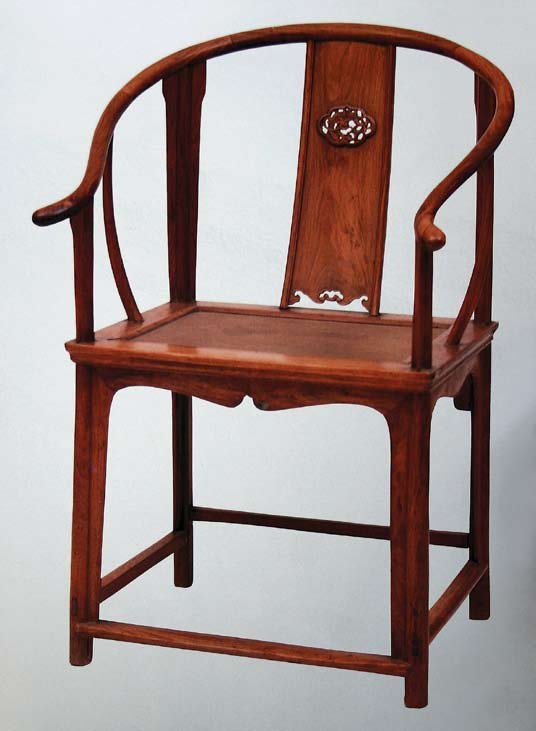
Round-backed armchair from the Ming Dynasty, well-proportioned in scale and lofty in shape.

The artisan system of the Ming Dynasty inherited the hereditary system of the Yuan Dynasty. Artisans had more personal freedom. During the non-service period, they had the freedom to be freely engaged in handicraft profession, which promoted the development of handicrafts.

The handicrafts of the Ming Dynasty achieved obvious development in both technology and art and many handicraft varieties formed their respective famous centers of production. Jingdezhen was the nationwide pottery-making center. During different periods there were different technological characteristics and various kinds of utensils, such as the Yashou Bei (a kind of cup) during the Yongle period (1403-1424), the celadon during the Xuande period (1426-1435), the colored celadon and the Ji Gang Bei (another kind of cup) during the period
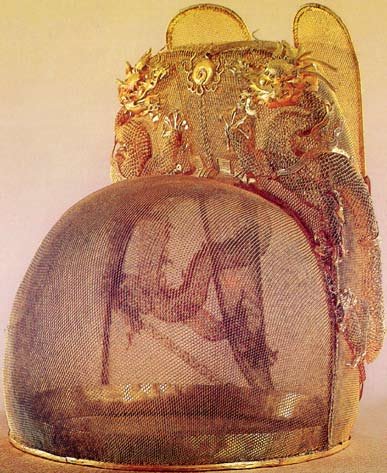
Gold crown from the Ming Dynasty, 24 cm high, woven with extremely thin gold filament, having two dragons vying with each other for a pearl on the top. It is one of the masterpieces of gold and silver handicrafts of Ming Dynasty.

of Chenghua (1465-1487), the monocolored glaze during the period of Zhengde (1506-1521), and the export-oriented porcelain during the period of Jiajing (1522-1565) and Wanli (1573-1619). The technology of dyeing and weaving in the Ming Dynasty developed by leaps and

bounds, such as the silk weaving in Suzhou and Hangzhou, the cotton weaving of Songjiang, the printing and dyeing of Wuhu, and the embroidery of the Gu School in Shanghai. The metal handicraft was featured with the Xuande Lu (a batch of small copperware cast with the copper mined in southeast Asia for meeting the demands of offering sacrifices to gods and ancestors as well as for lavendering clothes) and cloisonné (a kind of enamel with copper base and clipped copper wire). The development of garden buildings, the abundance of timer and the improvement of carpenter’s tools brought up the developed furniture handicraft of the Ming Dynasty, which was known for its simple and unsophisticated shape, perfect handicrafts and refined style. In the Ming Dynasty, numerous craftsmen came to the fore, such as Gong Chun and Shi Dabin killed in Zisha Tao (purple-clay pottery), Han Ximeng clever at the embroidery of the Gu School, Madame Ding skillful in cotton, Yang Xun accomplished in golden lacquer, Lu Zigang good at jade carving and the family of Zhu are talented at bamboo carving.
Read more

Arts and Crafts during the Primitive Society

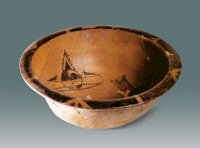
face profile painted pottery pot of the yangshao culture in neolithic age_sinoartsIn the early stage of human society, stone artifacts were the main implements of production. Through the fabrication of stone artifacts man had a better understanding of the effect and significance of hand and thus handicrafts gradually developed. As early as 1,700,000 years ago, at the age of the Yuanmou Man in Yunnam Province, China, the ancients of China began to make rough stone artifacts as implements or weapons for existence. At the time of the Upper Cave Man, that was 17,000 years ago, there were plentiful kinds of stone artifacts and in the respect of technological processing, the technology of drilling, scraping, polishing, and line engraving were already used. The technological fabrication could preliminarily meet the demand of man’s material life and the rudiment of decoration also appeared to reflect their aesthetic consciousness. The Upper Cave Man also learned how to drill wood to make fire. The development from preserving kindling material to bore wood to get fire showed the great improvement of man’s ability for existence. The use of fire made possible all the later crafts, like the invention of pottery and metallurgy, which was of extraordinary significance in the history of development of human culture.
In the process of material selection for stoneware, people found some “beautiful stones” with close grains and sparkling colors. With meticulous processing, they made the stones into ornaments either for carrying with them or being buried with them after death. Thus jade ware craft was developed and gradally became an independent variety of workmanship.
Buildings reflect man’s consciousness for settlement. In line with their respective geographic conditions, people of the clan society in ancient China built welling places in different styles,
semi-underground basemet in the northern Yellow River valley and nests on trees in the southern Yangtze River valley. For meeting the demand of dwelling, people also developed carpentry. From the dwellings ruins in Yuyao, Zhejiang, we ca see the people there already lived a kind of settle life in houses built with earth and wood seven thousand years ago.

Read more